
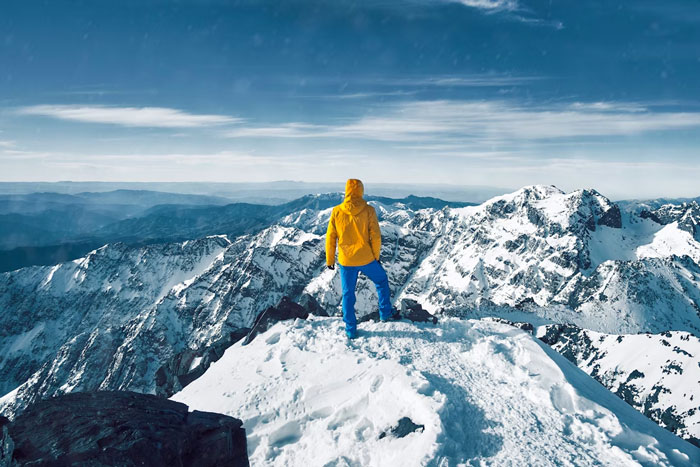
Toubkal National Park is one of Morocco’s most extraordinary natural treasures. Covering over 380,000 hectares across several High Atlas provinces, this protected area is home to Mount Toubkal (4,167 m)—the highest peak in North Africa.
Here, dramatic alpine landscapes meet ancient Berber culture. Deep valleys carved by glaciers, high-altitude plateaus, crystal-clear rivers, and remote mountain villages make Toubkal National Park a sanctuary for nature lovers, trekkers, and seekers of authenticity. Established in 1942, it is Morocco’s oldest national park and one of the most biologically rich regions in the country.
The geographic isolation and altitude variations of Toubkal National Park have created a remarkable biodiversity, making it a key conservation area in Morocco.
Among the mammals inhabiting the park are Barbary macaques, Atlas foxes, wild boars, golden jackals, porcupines, and the elusive Cuvier’s gazelle in remote areas. Above the valleys, birds of prey such as golden eagles, Bonelli’s eagles, lammergeiers, and Eurasian griffon vultures dominate the skies.
The flora changes dramatically with altitude. Lower slopes are dotted with juniper forests, holm oaks, and wild thyme, while higher elevations reveal Atlas cedars, mountain sage, lavender, and rare endemic alpine plants that bloom briefly during spring and summer. These fragile ecosystems are uniquely adapted to extreme temperature contrasts.
Toubkal National Park lies at the heart of the High Atlas Mountains, formed over 300 million years ago through tectonic uplift and volcanic activity. The region is dominated by igneous and metamorphic rocks, including basalt, granite, and schist.
During the Pleistocene Ice Age, glaciers sculpted the landscape, leaving behind U-shaped valleys, cirques, moraines, and glacial lakes, clear evidence of ancient ice fields. The most striking geological formations can be observed in the Aït Mizane Valley, Imlil Valley, and around the high passes leading to Mount Toubkal.
There is no single “best” time to visit Toubkal National Park—each season reveals a different personality of the mountains.
From December to March, the High Atlas transforms into a snow-covered alpine world. Snow blankets Mount Toubkal and surrounding peaks, creating Morocco’s most dramatic winter scenery. This is the season for snow trekking, winter ascents, and a rare chance to experience alpine conditions in North Africa.
Spring brings life back to the valleys. Snowmelt feeds rivers and waterfalls, wildflowers cover the slopes, and migratory birds return. This is one of the most beautiful seasons, ideal for trekking and photography.
While cities heat up, the High Atlas remains refreshingly cool. Summer reveals high-altitude pastures, crystal-clear streams, and long trekking days. Endemic plants, butterflies, and insects thrive, and mountain villages are full of seasonal activity.
Autumn paints the valleys in warm shades of gold and copper. Walnut and apple trees bear fruit, and the air becomes crisp and clear. It is one of the best times for hiking, with excellent visibility and fewer crowds.
For trekking enthusiasts, Toubkal National Park offers some of the most spectacular walking routes in Morocco:
Starting from Imlil, this iconic route leads to the summit of North Africa’s highest mountain. The trail passes through rugged valleys, high refuges, and breathtaking alpine terrain.
A scenic walk through traditional Berber villages, terraced fields, and river crossings, offering cultural immersion alongside natural beauty.
A classic trekking route connecting Imlil to the Imnane Valley, offering panoramic views of peaks, valleys, and remote settlements.
Known for its red rock formations and waterfalls, this route combines geological beauty with rich Berber heritage.
A multi-day trek crossing high passes, glacial valleys, and remote plateaus, ideal for experienced hikers seeking a deep wilderness experience.
Like Serra da Estrela in Portugal, Toubkal National Park is the soul of Morocco’s mountain landscapes. It is a place where geology, biodiversity, seasons, and human tradition coexist in perfect harmony.
Wild, powerful, and timeless, the High Atlas Mountains are not just a destination—they are an experience that stays with you long after the journey ends.